
How to learn your five first notes on the piano
Learning your first notes on the piano is an exciting milestone for any beginner. Whether you're starting from scratch or returning to the instrument after a long break, mastering just five notes on the piano can unlock countless simple melodies and build a strong foundation for your future musical journey.
In this article, we will show you how to learn your first notes on the piano. If you are a beginner and would like to learn the piano with an app, this is now possible with Tomplay. In Tomplay, you can learn the piano comfortably from home, at your own pace, one exercise at a time. Our dedicated lessons for absolute beginners include clear video lessons and fun activities to help you master your very first notes on the piano and soon play your first song — whether you dream of Adele, Coldplay or even Mozart.You’ll find a wide selection of beginner-friendly pieces to get you started straight away. You can even download and try Tomplay for free with the 14-day free trial.
▶️Download Tomplay and try out our beginner piano courses for free
Tomplay also offers an extensive catalogue of beginner piano sheet music,carefully arranged in several difficulty levels for beginner, intermediate and advanced pianists.
Are you ready to embark on your piano learning journey? Great! Before you learn your first notes, let’s make sure your body and hand positions are correct.
1. How to sit at the piano?
Before diving into your first notes on the piano, it’s essential to learn how to sit correctly at the instrument. Sit up straight, positioning yourself at the centre of the keyboard with both feet flat on the floor. Relax your shoulders. Place your hands on the keyboard and adjust your chair so that your arms are parallel to the floor — this will help you play comfortably and without tension.
▶️ Download Tomplay and try our beginner piano courses for free
2. How to position your hand on the piano?
Before you learn to play your first notes on the piano, it’s important to make sure your hand is well positioned. Good hand posture helps you play more comfortably, avoid unnecessary tension or pain, and develop better technique from the start. For the correct hand position, keep your wrists straight and your fingers curved, as if you are holding a small ball in your hand. Relax your hand and wrist but keep your fingers firm.
▶️ Download Tomplay and try our beginner piano courses for free
3. Find The First Five Notes on the Piano
Now that you're ready to play, it’s time to explore your first five notes on the piano. First we will focus on the right hand, so you can remove your left hand from the piano.
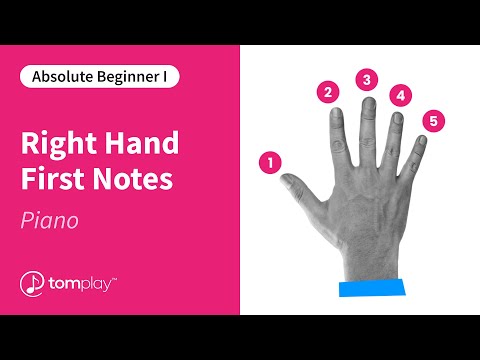
Start by learning the finger numbers, as they guide you towards the most natural and comfortable way to play. 1 is the thumb, 2 the index finger, 3 the middle finger, 4 the ring finger and 5 the little finger.
Find the group of two black keys in the centre of the piano and place your right hand thumb on the white key to the left of them. Then place your other fingers on the white keys to the right of it.
▶️Download Tomplay and try our beginner piano courses for free
The thumb rests on Middle C. The following notes on piano—played with fingers 2 to 5—are D, E, F and G. This fixed-hand shape is known as the C position, and it is the starting point for many beginner pieces.
4. Learn How to Read The First Notes on Sheet Music
Sheet music is used to represent musical notes on paper and shows you which notes to play on the piano. Learning how to read sheet music is an important step for any beginner, and it allows you to understand music in a clear and structured way.
The notes that you have just learnt look like this when they are written on a sheet music:
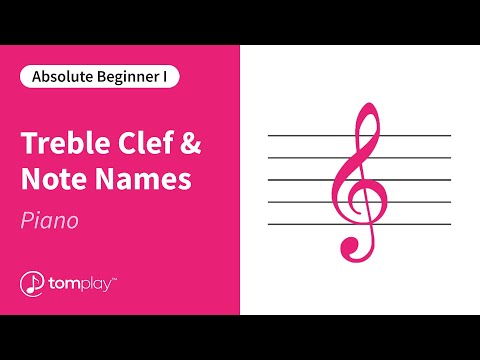
Each line and space represents a different note on the piano. Middle C is found underneath the staff and looks like a circle with a line through it. The next note up is D followed by E on the first line, then F and finally G on the second line.
The curvy symbol at the beginning is the treble clef and is written in front of notes played by the right hand, which are usually the higher notes on the piano. It is also known as the G clef because it curls around the line
that G is written on.
▶️ Download Tomplay and try our beginner piano courses for free
5. You are now Ready to Play your first piece!
You are now ready to play your first piece using sheet music! Feeling like playing classical music, pop, rock, or maybe a film music theme? Download Tomplay , and you will have access for free to the Piano Lesson. You will be able to choose from a variety of tunes, and play them with high quality backing tracks. Here we have selected Easy on me, level absolute beginner:

▶️ Download Tomplay and try our beginner piano courses for free
Well done! You’ve now learned the basics. You know how to sit at the piano, position your hands correctly, read your first notes on sheet music, and play them with your right hand. You’ve even played your very first piece, congratulations!
Learning your first notes on the piano is a simple yet powerful step toward becoming a confident player. With the right guidance and a bit of regular practice, you’ll be amazed at how quickly you begin to progress.
If this introduction has inspired you, download Tomplay today and discover our online piano courses for beginners — the perfect next step to continue building your skills at your own pace. In Lesson 2, you’ll learn the basic notes with your left hand. In Lessons 3 and 4, you’ll add new notes for both the right and left hands, preparing you to play more complete melodies. In Lessons 5, you’ll learn how to play with both hands together, and by the end of this lesson, you’ll be able to confidently play the basics using both hands.
The following lessons will then take you on a journey into music theory. In Lesson 6, you’ll learn about sharps and key signatures. This is followed by Lesson 7, where you’ll explore flats and deepen your understanding of key signatures. Finally, Lesson 8 is dedicated to learning how to play with dynamics, helping you add expression and musicality to your performances.
Sounds exciting, right? Don’t hesitate any longer — join the journey with Tomplay today and enjoy learning the piano step by step! 🎹✨
Add a comment...