We use cookies to improve our site and your experience. By continuing to browse our site you accept our Privacy Policy.
✖
Beethoven Sheet Music
About Beethoven
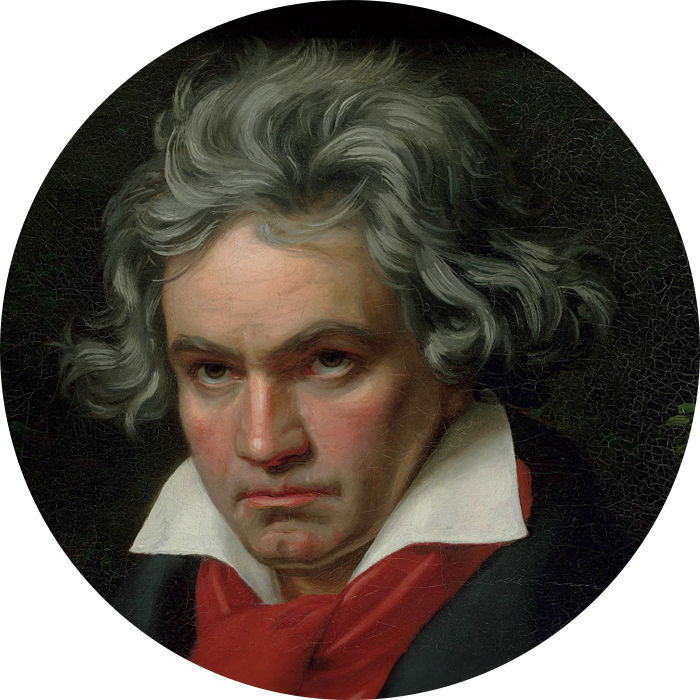
.The German composer Ludwig van Beethoven (1770-1827) had a difficult childhood, marked by an alcoholic father who forced him to practise the piano excessively. Despite these difficult beginnings, his exceptional musical talent was soon recognised and he became a pupil of renowned composers such as Christian Gottlob Neefe and Joseph Haydn. Beethoven composed in almost every musical genre of his time, from piano sonatas and symphonies to string quartets and concertos. His style evolved throughout his life, moving from Viennese classicism to a more personal and expressive romanticism. Beethoven was deeply influenced by the ideals of the French Revolution and the Aufklärung, which are reflected in works such as his Symphony No. 3, ‘Eroica’, and the ‘Ode to Joy’ from Symphony No. 9. His progressive deafness, which began around the age of 30, did not hinder his creativity but led him to more introspective compositions. The String Quartet No. 14 in C sharp minor, Op. 131, one of his last major works, is considered one of the pinnacles of chamber music. Beethoven is universally recognised as one of the greatest composers of all time, and his influence on Western music is immeasurable.
.The German composer Ludwig van Beethoven (1770-1827) had a difficult childhood, marked by an alcoholic father who forced him to practise the piano excessively. Despite these difficult beginnings, his exceptional musical talent was soon recognised and he became a pupil of renowned composers such as Christian Gottlob Neefe and Joseph Haydn. Beethoven composed in almost every musical genre of his time, from piano sonatas and symphonies to string quartets and concertos. His style evolved throughout his life, moving from Viennese classicism to a more personal and expressive romanticism. Beethoven was deeply influenced by the ideals of the French Revolution and the Aufklärung, which are reflected in works such as his Symphony No. 3, ‘Eroica’, and the ‘Ode to Joy’ from Symphony No. 9. His progressive deafness, which began around the age of 30, did not hinder his creativity but led him to more introspective compositions. The String Quartet No. 14 in C sharp minor, Op. 131, one of his last major works, is considered one of the pinnacles of chamber music. Beethoven is universally recognised as one of the greatest composers of all time, and his influence on Western music is immeasurable.
Our catalogue contains more than 100,000 interactive sheet music titles for 26 instruments. There are also exercises for beginner students, arrangements, and original classical pieces, as well as jazz, pop, rock and film music.
Take your scores with you wherever you are and play anywhere!
Download the Tomplay app for tablets and smartphones



 Watch the Video